Why do we need Version Control ?

You know what used to be the absolute worst part of coding? It wasn't the syntax errors or the missing semicolons. Honestly, it was just trying to move code from one computer to another without breaking the entire universe.
Before tools like Git existed, developers were essentially living in the Stone Age of software development. Let’s walk the path from sharing code using pendrives, emails to using something like Git. This will be a painful stroll down memory lane that perfectly illustrates why version control isn't just a luxury—it's a lifeline.
The Era of "Pigeons" and Pendrives
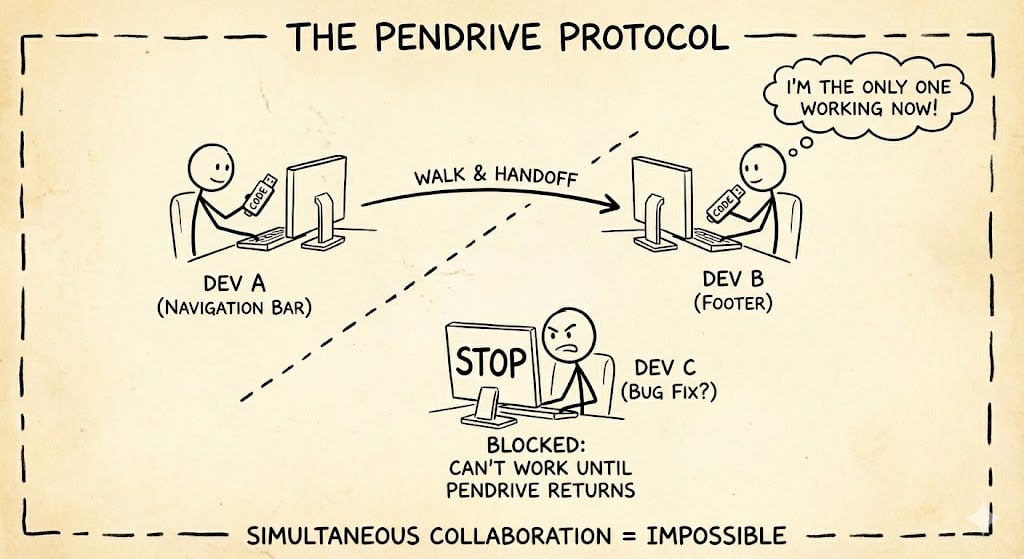
Picture this. It’s 2005. A developer finishes the navigation bar and needs to send it to a teammate to add the footer. There’s no cloud, no repository to push to.
So, they plug in a USB drive, copy the code, and physically walk it over to the next desk. The pendrive acted like a messenger—or a digital carrier pigeon—flying code from one developer to another.
This "Pigeon Protocol" worked... until it didn't.
The moment a developer held that pendrive, they became the sole person who can update the code. Nobody else could work on the code. If a third teammate found a bug while the drive was checked out? Unfortunately, there was nothing they could do. It was a massive hassle just to track down the bug, fix it and hand the pendrive back. Simultaneous collaboration wasn't just hard; it was physically impossible.
The Nightmare of Final_Final_Latest_v2
Without a real system, "version control" was often just a habit of renaming folders. Does this look familiar?
WebDev_Project_FinalWebDev_Project_Final_FinalWebDev_Project_Latest_REALWebDev_Project_Final_DO_NOT_TOUCH
Most developers have seen a desktop that looks like this. Not only was it incredibly confusing, but it was also a massive waste of resources. Teams were duplicating the entire codebase into new folders every time they wanted to save a "version," eating up memory and disk space for no good reason.
The Breaking Point: Why The Old Ways Failed
The "pendrive and folder" method had three fatal flaws that eventually drove development teams crazy:
No Collaboration History: If a line of code broke the app, it was impossible to know who wrote it or why.
The "Out of Sync" Problem: Since simultaneous work was impossible, developers were constantly overwriting each other's work. One person would fix a feature, another would copy their folder over it, and poof—the fix was gone.
The "Undo" Problem: If you deleted a crucial function and saved the file, that was it. The old code was technically useless and often irretrievable unless it had been manually backed up in one of those
Final_v2folders.
Enter Version Control: The Single Source of Truth
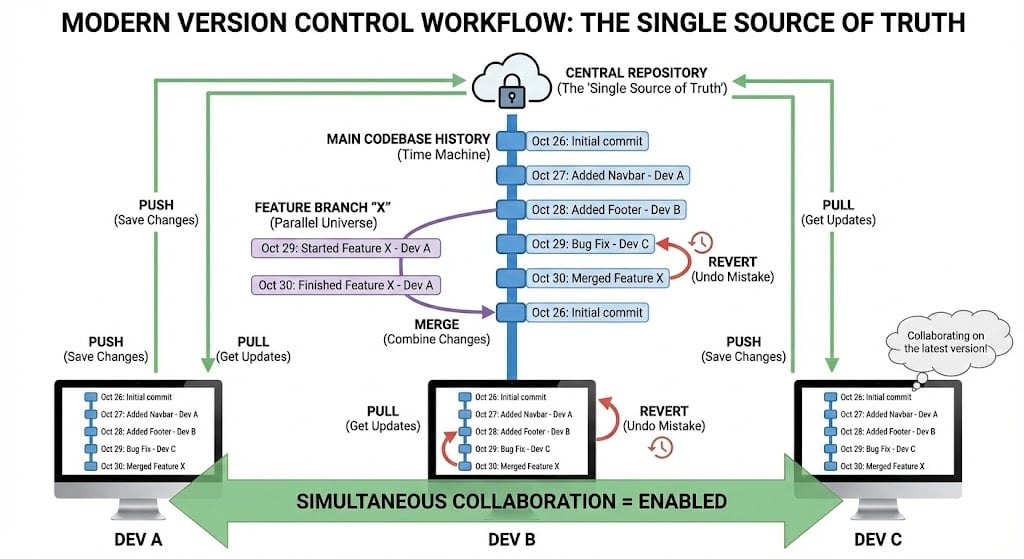
This is why modern Version Control Systems (VCS) are so important. They solve the chaos by becoming the Single Source of Truth.
Think of a VCS (like Git) as a time machine for a project.
It tracks everything: You can view the entire history of the code. Every change, every deletion, every author is recorded.
It allows for "Universes": Developers can create branches (parallel universes) to work on features without disturbing the main code.
It saves the day: Did a bug slip through? No problem. You can instantly revert back to the working code from an hour ago.
For people who’re curious minded like me, here’s an article on how Linus Torvalds came up with git: https://www.linuxjournal.com/content/git-origin-story